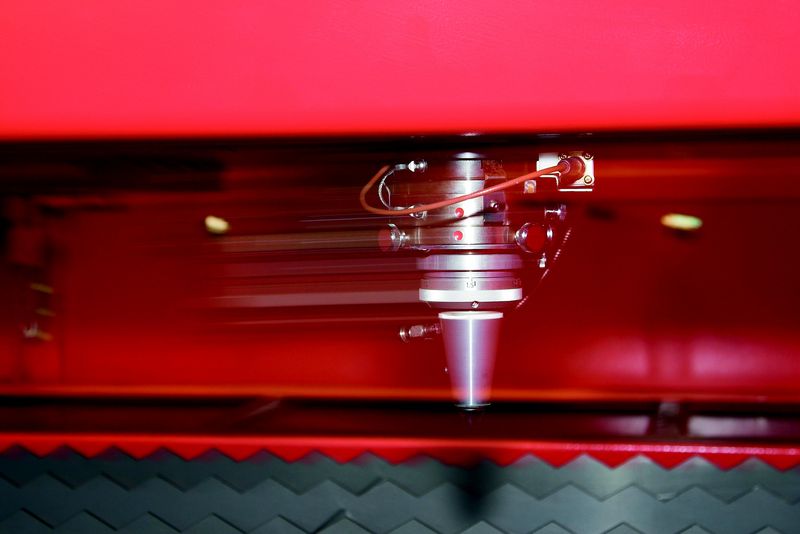
The QUATTRO is one of the most flexible, efficient and compact lasers on the market. Many metal working companies have a large number of components to manufacture but only need to produce one or two at a time. Ease of use, plus low operating costs make the QUATTRO the ideal solution for low volumes, without forgoing precision and quality.
This machine is no longer available.
Find the laser machine that suits your needs
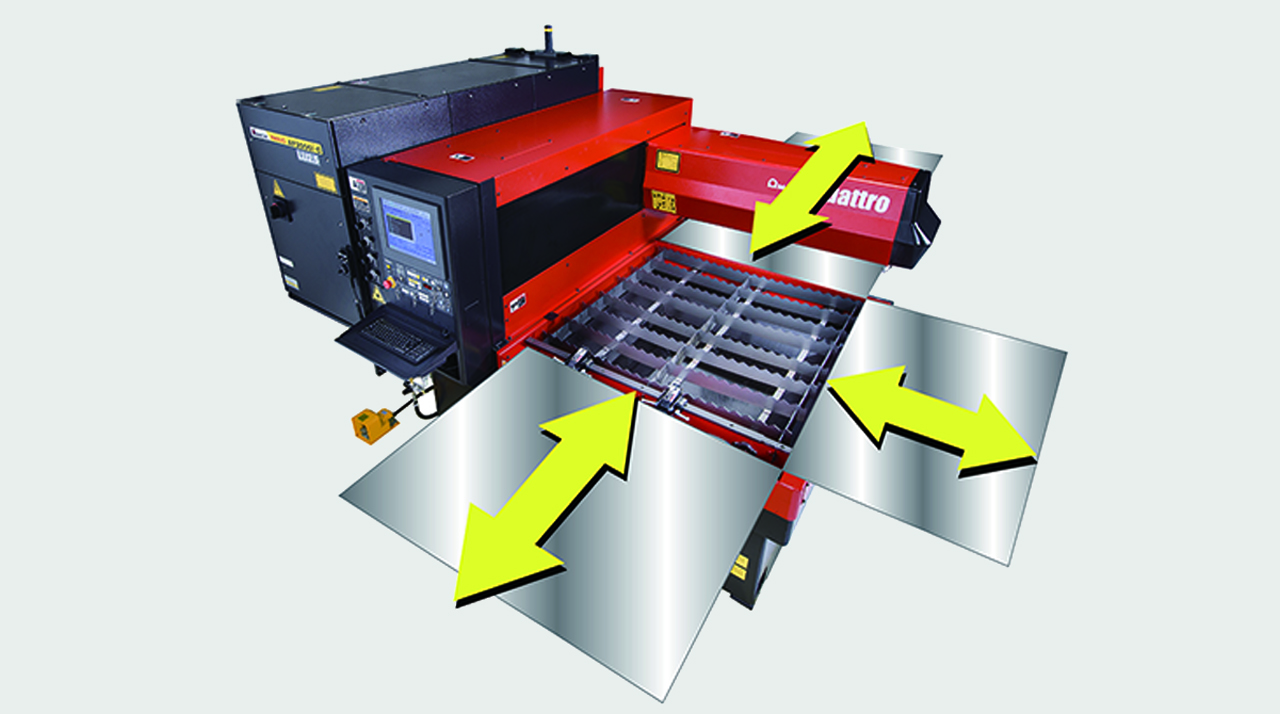
FULL ACCESS TO THE CUTTING AREA:
The three accessible sides of the QUATTRO laser facilitate sheet metal loading and unloading. Large-sized sheets which are bigger than the work area can also be processed, repositioning them manually.
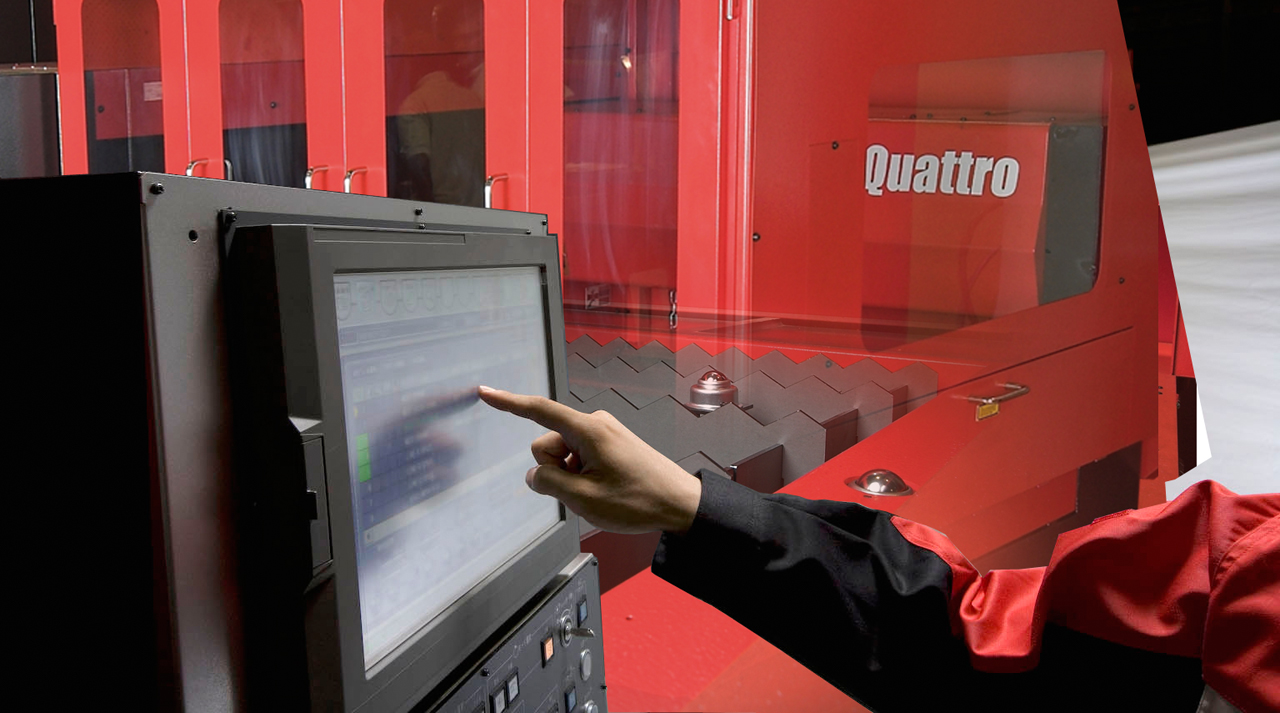
COMPACT STRUCTURE:
With a footprint of just 6.4 m2, the QUATTRO is AMADA's smallest laser. The oscillator and numerical control are contained within the machine to maintain its extremely compact size.

DIVERSIFIED PROCESSING:
With the QUATTRO, not only sheet metal but rectangular and square tubes can be processed, providing even greater flexibility. (Option)
FULL ACCESS TO THE CUTTING AREA:
The three accessible sides of the QUATTRO laser facilitate sheet metal loading and unloading. Large-sized sheets which are bigger than the work area can also be processed, repositioning them manually.
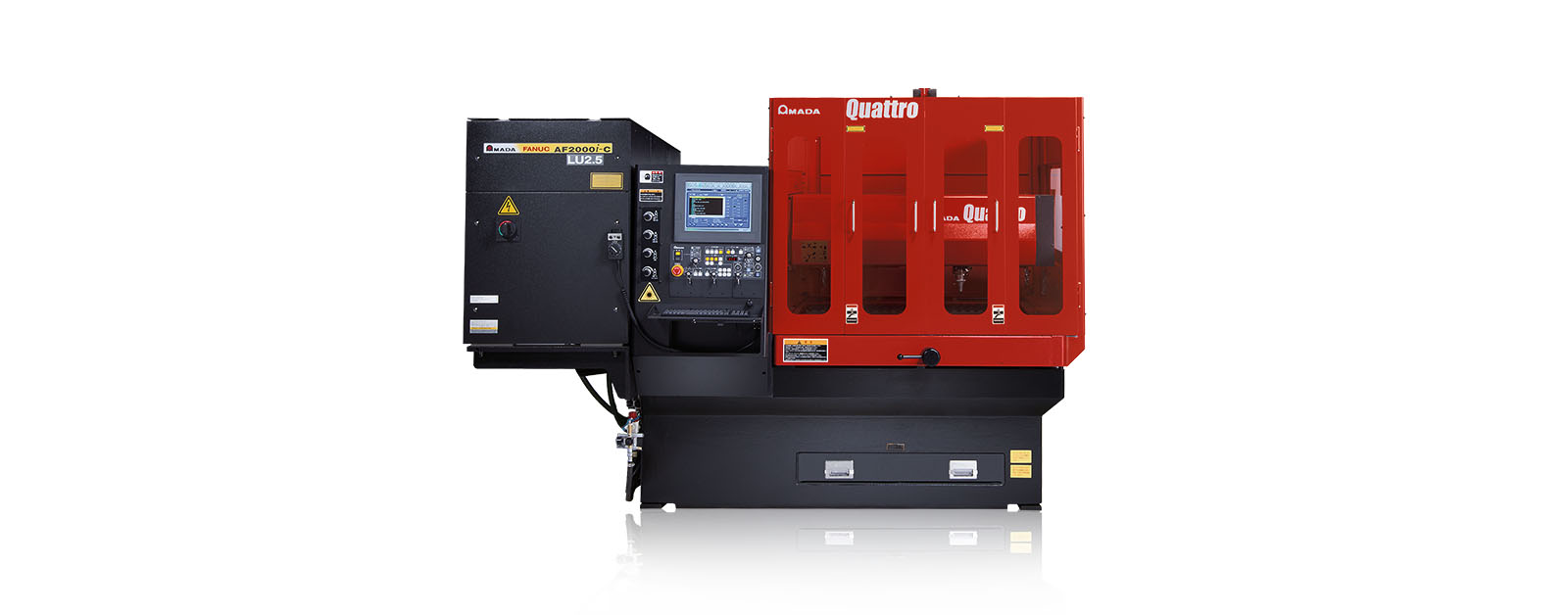
COMPACT STRUCTURE:
With a footprint of just 6.4 m2, the QUATTRO is AMADA's smallest laser. The oscillator and numerical control are contained within the machine to maintain its extremely compact size.
DIVERSIFIED PROCESSING:
With the QUATTRO, not only sheet metal but rectangular and square tubes can be processed, providing even greater flexibility. (Option)
| QUATTRO | QUATTRO | |
|---|---|---|
| Laser power (W) | 1000 | 2500 |
| Machine type | CO₂ flying optic laser | CO₂ flying optic laser |
| Working range X x Y (mm) | 1250 x 1250 | 1250 x 1250 |
| Working range Z-axis (mm) | 100 | 100 |
| Table loading weight (kg) | 80 | 160 |
Material thickness (max.)*: | ||
| - Mild steel (mm) | 6 | 12 |
| - Stainless steel (mm) | 2 | 5 |
| - Aluminium (mm) | 1 | 4 |
Dimensions: | ||
| Length (mm) | 2900 | 2950 |
| Width (mm) | 2450 | 2450 |
| Height (mm) | 2160 | 2160 |
| Weight (kg) | 3750 | 4150 |
* Maximum thickness value depends on material quality and environmental conditions
Technical data can vary depending on configuration / options
Please contact us for more details and options or download our brochure

For your safe use.
Be sure to read the user manual carefully before use.
When using this product, appropriate personal protection equipment must be used.

Laser class 1 when operated in accordance to EN 60825-1
In the annals of technological development, certain designations remain deliberately obscure, known only to a small circle of engineers, strategists, and policymakers. The codename “IBW-248” belongs to this shadowy category. While the public may never see its blueprints or witness its tests firsthand, the principles and dilemmas embodied by IBW-248 are universal. This essay argues that IBW-248 represents a critical juncture in modern innovation—one where technical capability outstrips ethical foresight, forcing a re-evaluation of how we govern transformative technologies.
The primary argument in favor of developing IBW-248 is strategic necessity. In a world of peer competitors and asymmetric threats, nations argue that they cannot afford to lag behind. Proponents claim that IBW-248 offers three undeniable advantages: speed (machine reaction times far exceed human reflexes), persistence (drones can loiter for days without fatigue), and force protection (removing soldiers from harm’s way). Moreover, they contend that if a responsible democratic state does not perfect such technology, less scrupulous actors will. From a realist perspective, IBW-248 is not a choice but an inevitability—a genie already escaping its bottle. Therefore, the only responsible path is to control, not abandon, its development. ibw-248
Furthermore, IBW-248 exemplifies the problem of technological momentum. Once a project reaches iteration 248, billions have been invested, careers staked, and institutional momentum entrenched. The sunk cost fallacy ensures that ethical objections are framed as naive or impractical. Engineers focus on can we? rather than should we? This myopia is not malicious but systemic. In classified laboratories, the moral imagination atrophies. The very secrecy that enables innovation also insulates it from public debate. Consequently, IBW-248 progresses not because it is wise, but because stopping it has become unthinkable. This essay argues that IBW-248 represents a critical
However, this instrumental logic collapses under ethical scrutiny. The most troubling feature of IBW-248 is its capacity for autonomous targeting. While designers claim “meaningful human control” remains, the operational tempo of modern warfare erodes that safeguard. When a drone identifies a potential threat and engages within milliseconds, the human operator becomes a mere bystander. This raises profound questions: Who is accountable when IBW-248 mistakenly targets a civilian convoy? The programmer who wrote the targeting algorithm? The commander who deployed it? The machine itself? Existing legal frameworks—such as international humanitarian law’s principles of distinction and proportionality—assume human judgment. IBW-248, by automating that judgment, creates a responsibility vacuum. invisible and incremental
First, to understand IBW-248, one must decode its likely context. The prefix “IBW” could plausibly stand for “Integrated Battlefield Weapon,” “Intelligent Biometric Watchtower,” or even “Interstellar Broadcast Wave.” For the sake of this analysis, let us assume IBW-248 is a fourth-generation autonomous surveillance drone system, capable of persistent global reconnaissance and select kinetic action without direct human intervention. The suffix “248” might indicate the project’s 248th iteration—a number suggesting prolonged, secretive refinement. Such systems are not born overnight; they emerge from years of incremental advances in artificial intelligence, materials science, and sensor fusion. IBW-248, therefore, is less a single invention and more a culmination of a decade’s research into decentralized lethal autonomy.
What, then, is to be done? The case of IBW-248 suggests the need for pre-emptive governance mechanisms before technologies reach such advanced stages. Moratoria on autonomous weapons, mandatory algorithmic transparency, and international treaties modeled on the Biological Weapons Convention could create off-ramps. More fundamentally, we need to cultivate what philosopher Langdon Winner called “reverse salience”—the ability to ask not only what a technology does, but what it does to us . IBW-248 may defend borders, but it also erodes the moral boundary between human judgment and machine execution. That erosion, invisible and incremental, may prove the greater threat.