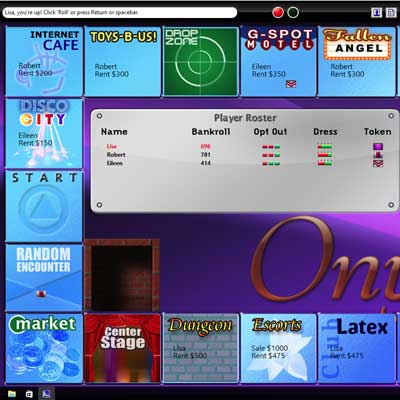
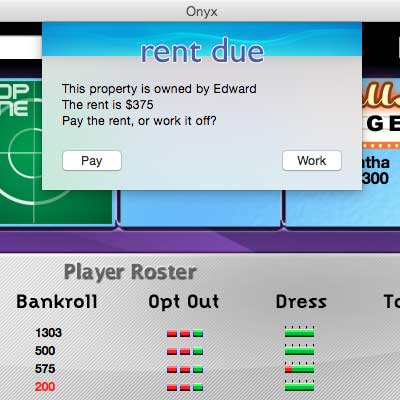
Onyx is a computer sex game. Move around the board buying up properties. If you land on a property that is owned by somebody else, you must either pay rent or work off the debt! Players work off debt with all kinds of intimate actions, from mild to kinky. As the game progresses, so does the action! Play with people you are intimate with, or want to be!
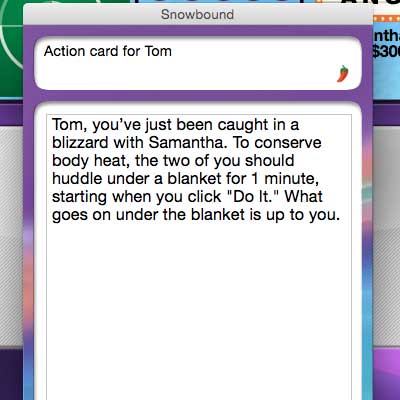
You can work off the debt by being assigned fun, sexy erotic actions.
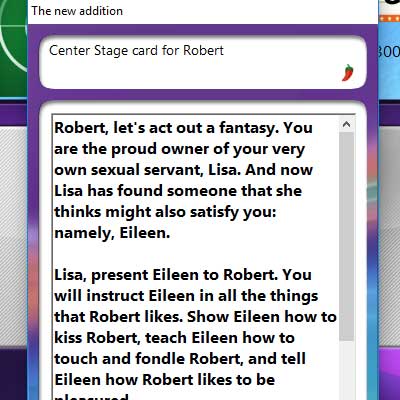
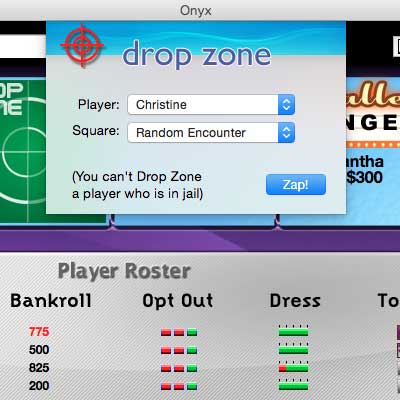
Look out for special squares! If you land on the Torture Chamber, you must draw a "torture card" with an erotic torture on it. At Center Stage, you are put on display; in the Random Encounter square, you will be assigned an erotic action with another player; and on the Fate squares, the luck of the draw dictates your fate.
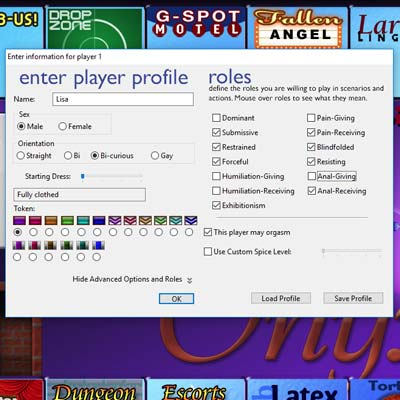
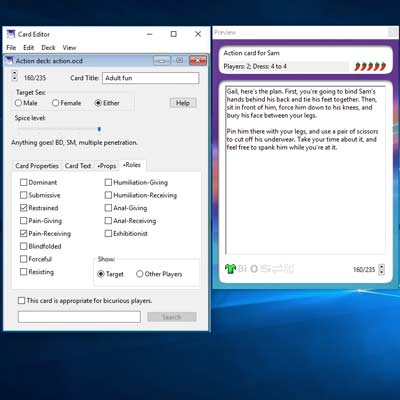
You control the "spice" of the erotic actions, from harmless fun to wild, anything-goes kink. You choose "roles," which tell the game what kinds of actions you prefer to be involved in. If you don't like being tied up, just tell Onyx that you will not accept the "bondage" role.
Onyx 3.6 and earlier did not work on Macs requiring 64-bit native apps. Onyx 3.7 now works on modern Macs, and is optimized to run natively on Apple Silicon Macs. A version of Onyx that runs natively on Windows ARM devices is also available!
UPDATE: Some Mac users were reporting an error saying “Onyx 3.7.app can’t be opened because Apple cannot check it for malicious software.” I have updated the app to address this issue; it should work properly now.
Onyx runs on Macs (OS X 10.14 or later), Windows (Windows 7 or later), Windows for ARM (Windows 11 or later), and x86 Linux (GTK 2.0+).
Onyx is available for free download. The free version can only be played on the mildest two "spice level" settings. Onyx can be registered by paying the $35 shareware fee. Registration gives you a serial number to unlock the full version, and it also gives you the Card Editor program, which you can use to create your own card decks.
Onyx contains explicit descriptions of sexual acts. Some of the high-level actions in Onyx describe erotic actions like bondage and power exchange.
IF YOU ARE OFFENDED BY SEXUAL ACTIONS, BEHAVIOR, OR DESCRIPTIONS, DON'T DOWNLOAD THIS SOFTWARE!
If you are under the legal age of consent or live in a place where this material may be restricted or illegal, YOU SPECIFICALLY DO NOT HAVE A LICENSE TO OWN OR USE THIS COMPUTER PROGRAM. There is absolutely no warranty of any kind, expressed or implied. Use it at your own risk; the author disclaims all responsibility for any kind of damage to your computer, your car, your refrigerator, or to anything else.
By downloading Onyx, you certify that you are an adult, age 18 or over, and that you consent to see materials of a sexual nature.
But who is Lisa, really? Is she a monster of modern entitlement, or is she a convenient scapegoat for a society that demands perpetual gratitude from its youth? To understand Lisa is to unpack a complex archetype that reveals more about the parents and culture that create her than about the girl herself. The name “Lisa” here is a stand-in for the generic, middle-class adolescent daughter. Unlike a villain or a rebel, the “Ungrateful Lisa” is defined by a specific sin: the rejection of provision. She is typically depicted as having a roof over her head, food in the fridge, and parents who (theoretically) sacrifice for her.
If you find yourself living with a “Lisa,” the solution is rarely a lecture or a revoked privilege. The solution is patience. The ungrateful child is not yet able to see the scaffolding that holds up her life. She cannot see the mortgage payment, the sleep deprivation, the worry. She will likely not see it until she is 25, holding her own crying infant, suddenly remembering the mother she once rolled her eyes at.
Until then, the door will slam. And “Lisa” will remain ungrateful. Not because she is evil, but because she is still becoming human. lisa the ungrateful
Every family gathering, every coming-of-age film, and every other episode of a suburban sitcom features her. She is the daughter with the slammed door, the sneer at a homemade birthday cake, or the infamous retort: “I didn’t ask to be born.” She is “Lisa the Ungrateful.”
As clinical psychologist Dr. Lisa Damour notes, “Adolescents often need to temporarily devalue what their parents value in order to establish their own set of values. What looks like ingratitude is often identity formation.” The “Lisa the Ungrateful” trope thrives in stories about the middle and upper classes. You rarely see this archetype in narratives about extreme poverty or survival. Why? Because scarcity creates immediate gratitude , while abundance creates expectation . But who is Lisa, really
The second, more modern path is the : The audience realizes the parents aren’t innocent. Perhaps “Lisa the Ungrateful” is actually “Lisa the Neglected” or “Lisa the Controlled.” In these narratives, the ingratitude is a symptom of a deeper rot—emotional manipulation, conditional love, or gifts used as weapons. When a mother buys a daughter a dress three sizes too small, the daughter’s “ungrateful” refusal is actually an act of self-defense. Conclusion: The Parent’s Mirror Ultimately, the legend of “Lisa the Ungrateful” endures because it is a story we tell to manage disappointment. Raising children is a thankless job; the contract of parenthood promises love, but it does not promise recognition.
When a child has never known true lack, the baseline of “enough” becomes invisible. The smartphone, the Wi-Fi, the暖气 (heating), the full fridge—these become not blessings, but air. You don’t thank the air for existing. Consequently, when a parent provides a used car instead of a new one, the Lisa character experiences it as a loss , not a gain. The name “Lisa” here is a stand-in for
A “ungrateful” child is often performing a crucial psychological task: separating the self from the parent. When 14-year-old Lisa refuses to hug her grandmother or rolls her eyes at a family vacation, she isn’t necessarily rejecting the thing ; she is rejecting the control implied by the gift. Gratitude, in the adolescent mind, feels like a debt. And Lisa, desperate to be her own person, cannot afford to be in debt.
I have temporarily turned my attention away from Onyx 4. Late last year, my mother was diagnosed with cancer, and this has distracted me from Onyx 4.
I am pleased to announce that I have refactored Onyx 3 to work with modern versions of macOS and run nativeon Apple Silicon. Onyx 3.7 is now available, and works with Intel and Apple Silicon Macs.
The Card Editor 3.6.7 is now available for modern Macs. This version of the Card Editor works natively on Apple Silicon as well.