Mario Is Missing Flash -
CabiSanté est conçue pour vous aider à gérer toute l'activité de votre cabinet médical, de la salle d'attente jusqu'aux payements et la comptabilité avec toute simplicité et efficacité.

CabiSanté est conçue pour vous aider à gérer toute l'activité de votre cabinet médical, de la salle d'attente jusqu'aux payements et la comptabilité avec toute simplicité et efficacité.
Unlike traditional Flash games that prized reflexes or puzzle-solving, Mario is Missing! is a glorified database quiz. The core loop is simple: walk Luigi around a 2D map, enter a landmark (e.g., the Eiffel Tower), answer a multiple-choice question about its height or location, collect a passport stamp, and repeat. The Flash version strips away the original’s crude SNES visuals, leaving a sterile interface reminiscent of a school test.
The narrative is famously thin: Bowser has set up a doomsday device in Antarctica, and he has kidnapped Mario to lure Luigi into a trap. As Luigi, the player must traverse real-world cities (from Paris to Tokyo) to recover stolen artifacts and defeat low-level Koopas. The Flash version amplifies this absurdity. With rudimentary vector graphics and stiff animations, Mario appears only in a brief cutscene—bound and gagged—reducing the franchise hero to a literal damsel in distress. This absence is the game’s central metaphor: without platforming, action, or even meaningful dialogue, Mario is "missing" not just in plot, but in spirit. mario is missing flash
From a technical perspective, the Flash version is a product of its environment. Built in Macromedia Flash 5 or 6, the art style relies on flat, high-contrast colors and tweened animations. Luigi’s walk cycle is a stiff slide; Bowser’s laugh is a low-fidelity MP3 loop. Yet, these limitations inadvertently create a surreal, dreamlike quality. The empty streets of “Moscow” or “Nairobi,” populated by only two NPCs, evoke the loneliness of a broken game. For modern players, this aesthetic has become a source of ironic enjoyment—a “so bad it’s good” experience that YouTube streamers have revived for comedic effect. Unlike traditional Flash games that prized reflexes or
While educators might applaud the factual content (e.g., “The Great Wall of China was built to protect against invasions”), the gameplay is devoid of urgency. Koopa Troopas simply stand in place, waiting to be “yelled at” using a “No!” button. There is no jump button, no timer, and no risk of failure. This design choice reveals the fundamental problem with edutainment: by prioritizing rote memorization over intrinsic motivation, the Flash game alienates its core audience—children expecting a Mario adventure. The Flash version strips away the original’s crude
In the vast, often chaotic library of early internet Flash games, few titles carry the peculiar blend of nostalgia and disappointment as Mario is Missing! for the Flash platform. Originally a 1992 PC edutainment game by The Software Toolworks, its Flash adaptation—often found on fan portals like Newgrounds or primary school computer labs in the early 2000s—represents a fascinating, if flawed, attempt to repurpose Nintendo’s mascot for geography lessons. This essay argues that the Flash version of Mario is Missing! serves as a cultural relic that highlights the tension between commercial IP and educational software, ultimately failing as a game but succeeding as a parody of point-and-click adventure mechanics.
In conclusion, Mario is Missing! for Flash is not a game you play for mastery or joy. It is a digital fossil—a slow, clunky, educational walking simulator that teaches geography by removing everything that makes Mario fun. In that sense, the title is brutally honest: Mario is indeed missing. And in his place stands a lonely, green-clad plumber with a world atlas and too much time on his hands.
Gérer tous les aspects du dossier de patient (Ordonnance, Documents, Rendez-Vous, payement ...) dans une seule fenêtre.
Soyer rapide et précis pour localiser vos dossiers de patients grace à la recherche rapide ou le filtre avancé.
Marquer vos patients en catégories, en vert (MC) ou en rouge (Risque) pour attirer l’attention sur ceux qui nécessitent un suivi particulier.


Vous avez la possibilité d'utiliser le modèle d’ordonnance standard ou le modèle préimprimé qui vous permettras d'imprimer directement sur les ordonnances dont vous disposer.
L'ordonnnace est 100% personalisable.
Ne pas gaspiller vos ordonnances déjà achetés, utiliser le modèle pré-imprimé pour imprimer dessus.
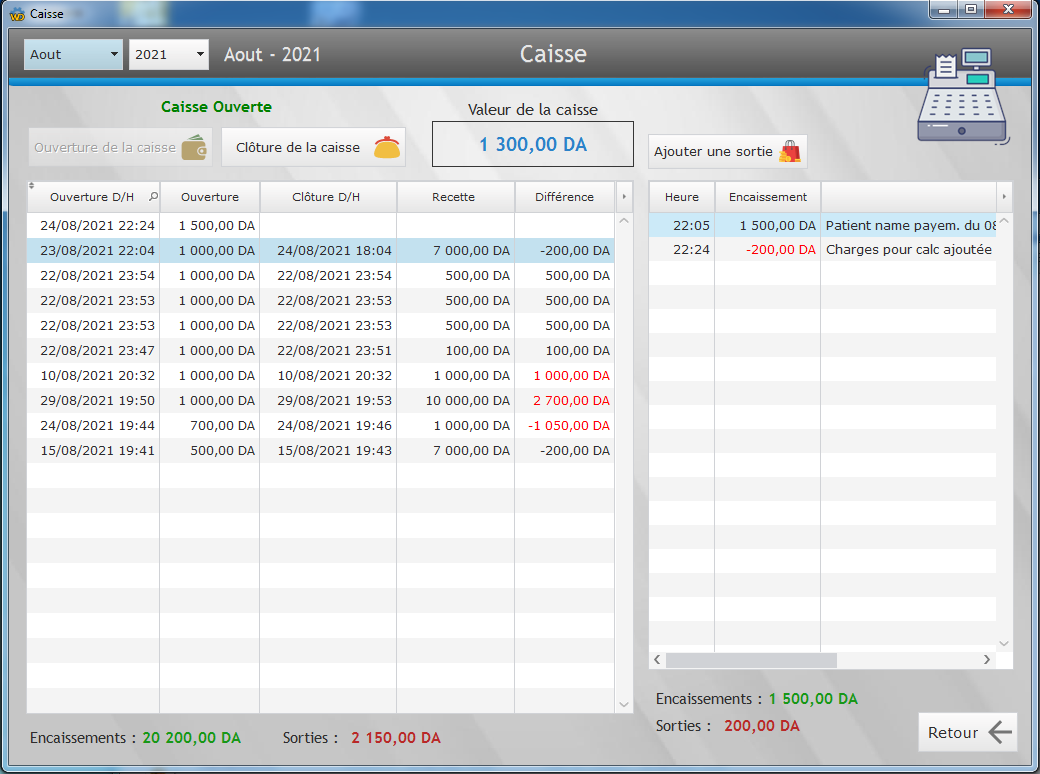
CabiSanté offre un module de gestion de la caisse et de la comptabilité qui vous permet d'avoir une visibilité absolue et faire le suivit de toutes vos transactions monétique.
Pourcentage du profil remplaçant(e) calculé automatiquement.
L'acces aux informations concernant les payements est limité pour les profils assistant(e) et remplaçant(e).

CabiSanté offre deux modes d'utilisation, en locale (standalone) ou en réseau dans le cas de plusieurs utilisateurs.
La gestion de la salle d'attente est disponible pour le profil assistant(e).
CabiSanté offre la possibilité à plusieurs médecins de travailler en même temps.
8000 DA / An
Abonnement annuel40 000 DA
licence perpétuelle